Managing Cash Flow
Managing the cash flow is an essential part of every business owner’s job. The importance of cash flow management was highlighted in the ongoing COVID-19 global pandemic, which caught the world by surprise. Sudden government mandated lockdowns have caused many small businesses to be affected and many such businesses have also closed their doors for good. The main reason behind their unfortunate demise was due to the poor cash management, resulting in a lack of cash to sustain operations.
What is Cash Flow?
In order to manage cash flow, we first need to understand the meaning of cash flow. In simple terms, cash flow is the net effect of the cash flowing into and out of your business. A positive cash flow would indicate that you have more cash flowing into your business than outflows. Similarly, a negative cash flow would mean vice versa.
Some business owners may think that all is good since their businesses are earning a profit. However, profits do not equate to cash flows. This is because the accounting records are based on an accrual basis, not on a cash basis. This is governed by the accounting standards under the Financial Reporting Standards (FRS) for consistency and comparability. A simple example would be when you make a sale on credit, you recognise sales, which is reflected in your profit. However, since you have not collected the money from your customer, your cash still shows zero inflow. Therefore, profit and cash flow measure different aspects of the financial performance of your business.
Reading The Cash Flow Statement
The first step to improving your cash flow would be to analyse where the cash inflows and outflows are coming from. To do so, you need to understand how to read the cash flow statement in your financial statements provided by your accountant. In your statement of cash flows, there are typically 3 sections: cash flows from operating activities, cash flows from investing activities and cash flows from financing activities.
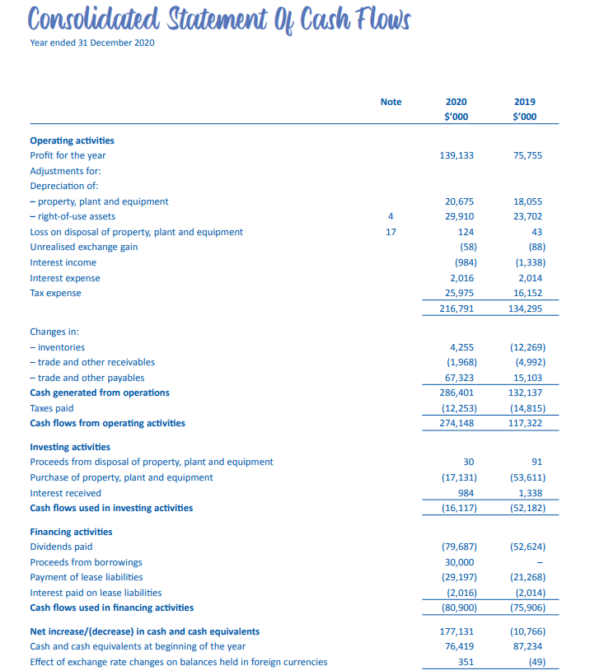
*Extracted from Sheng Siong Group’s Annual Report for FY2020.
Cashflows from operating activities represent cash generated from its regular business activities such as selling of goods or providing services. A negative cash outflow here would mean that the business operations are consuming more cash than the cash generated.
Cashflows from investing activities usually refer to long-term investments and capital expenditures. This consists of acquisition of plant and equipment and investments in other businesses etc. Cash used here is usually discretionary in nature and volatile from year to year due to the relatively irregular nature of capital expenditures.
Cashflows from financing activities relate to cash obtained from financing the business such as issuance of shares or borrowings from loans. It also includes repayments made to loans as well as dividends paid to shareholders.
Managing cashflows from investing and financing activities require strategic planning as these decisions affect the long-term future of the company. For instance, a lack of investment in capital expenditures could result in lower productivity of the business in the future.
For more immediate results, managing cash flow from operating activities would be your best bet. One way to do so would be via managing your working capital.
Working Capital
Working capital comprises inventory, trade receivables, trade payables and other current assets and liabilities. Managing this directly affects the speed at which your cash is being generated, also known as the cash conversion cycle (“CCC”).
The CCC is the time it takes for you to convert your inputs into cash and is mathematically demonstrated below:
CCC = DIO + DSO - DPO
DIO = Days Inventory Outstanding
DSO = Days Sales Outstanding
DPO = Days Purchases Outstanding
DIO is calculated through the following formula:
DIO = (Average Inventory / Cost of Goods Sold) X 365 days
Average Inventory = (Beginning Inventory + Ending Inventory) / 2
DSO and DPO are calculated in a similar fashion:
DSO = (Average Trade Receivables / Sales) X 365 days
Average Trade Receivables = (Beginning Trade Receivables + Ending Trade Receivables) / 2
DPO = (Average Trade Payables / Cost of Goods Sold) X 365 days
Average Trade Receivables = (Beginning Trade Payables + Ending Trade Payables) / 2
Assuming that your DIO is 30 days, DSO is 40 days and DPO is 20 days, this would give a CCC of (30+40-20)= 50 days.
With this information, you would be able to establish a baseline CCC for your future measurement after implementing new cash management initiatives.
Improving Cash Flow
Based on the CCC formula above, improving cash flow would mean you’ll have to either reduce your DIO/DSO or both or increase your DPO.
Firstly, reducing your DIO could be achieved through more accurate forecasting of sales to optimise your inventory levels. A high DIO may be associated with overstocking, leading to higher than necessary storage costs and a high level of obsolete stock that may never be sold. However, if the DIO is too low, your business could struggle to meet a sudden increase in demand or a sudden shortage of supply due to border controls, especially during this highly uncertain business environment.
Secondly, reducing your DSO could be done through several ways. Is your business too liberal with your credit terms? Perhaps you can adopt more stringent credit controls for your customers. Are there customers which have been delaying their payments, maybe you’ll have to follow up with them more actively to receive payments faster. An electronic invoice these days would also be faster than the traditional paper invoice, especially with the prevalence of remote working, speeding up the payment process.
Finally, a low DPO could suggest that you are not taking full advantage of the credit terms given by your suppliers. You could also negotiate with your suppliers for longer credit terms but this would have to be balanced against the early payment discounts offered by your suppliers.
Conclusion
Managing your cash flow well could be key to the survival of your business in these uncertain times.
*Written on 3rd August 2021.